Breaker keeps tripping: what to do first
A breaker that trips is doing its job. The useful question is why, and a few minutes with the panel and your appliances usually narrows it down before anyone arrives.
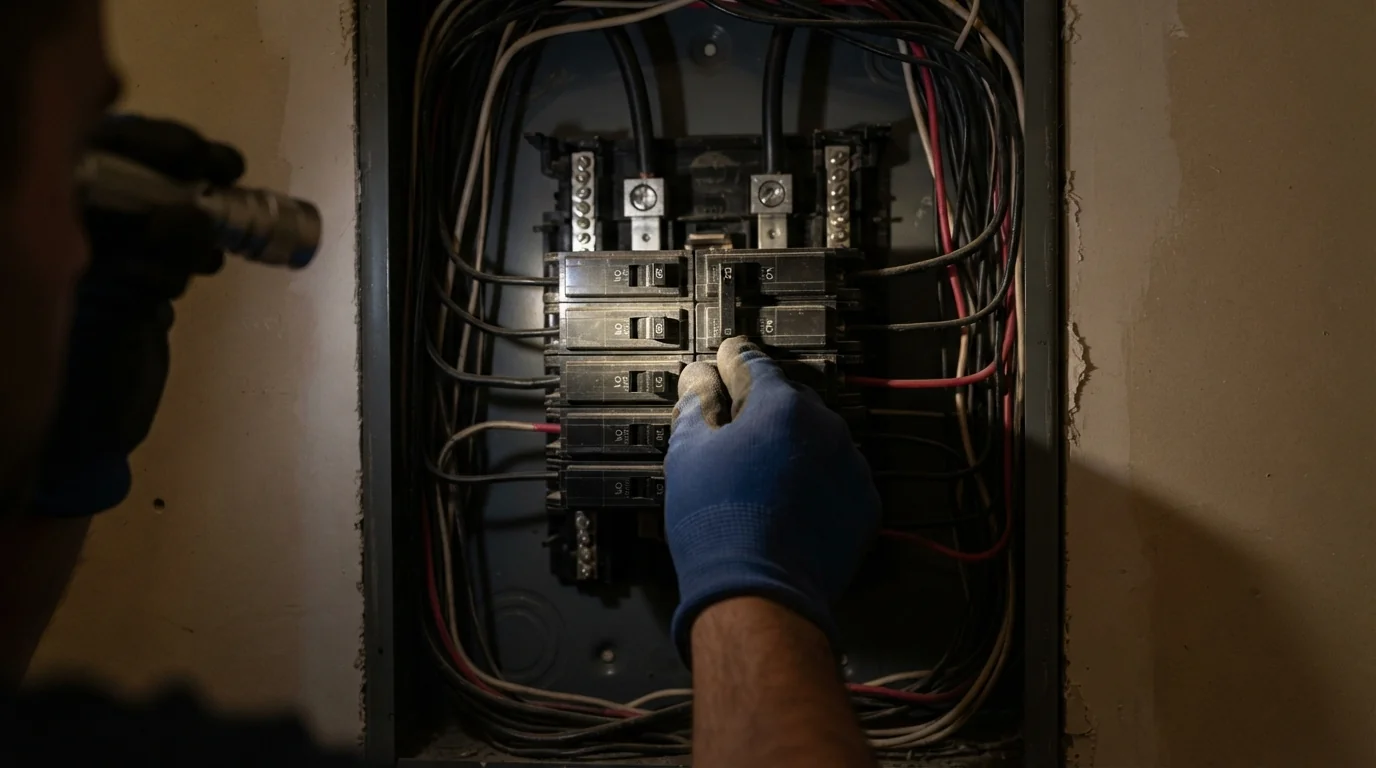
When a breaker keeps tripping in a New York home, unplug everything on that circuit, reset the breaker by pushing it fully off and then on, and plug things back in one at a time. If it trips again with nothing plugged in, trips instantly, feels warm, or you smell burning, stop resetting it and call an electrician.
Rather ask a person?(929) 755-0293Step one: find the circuit and unplug
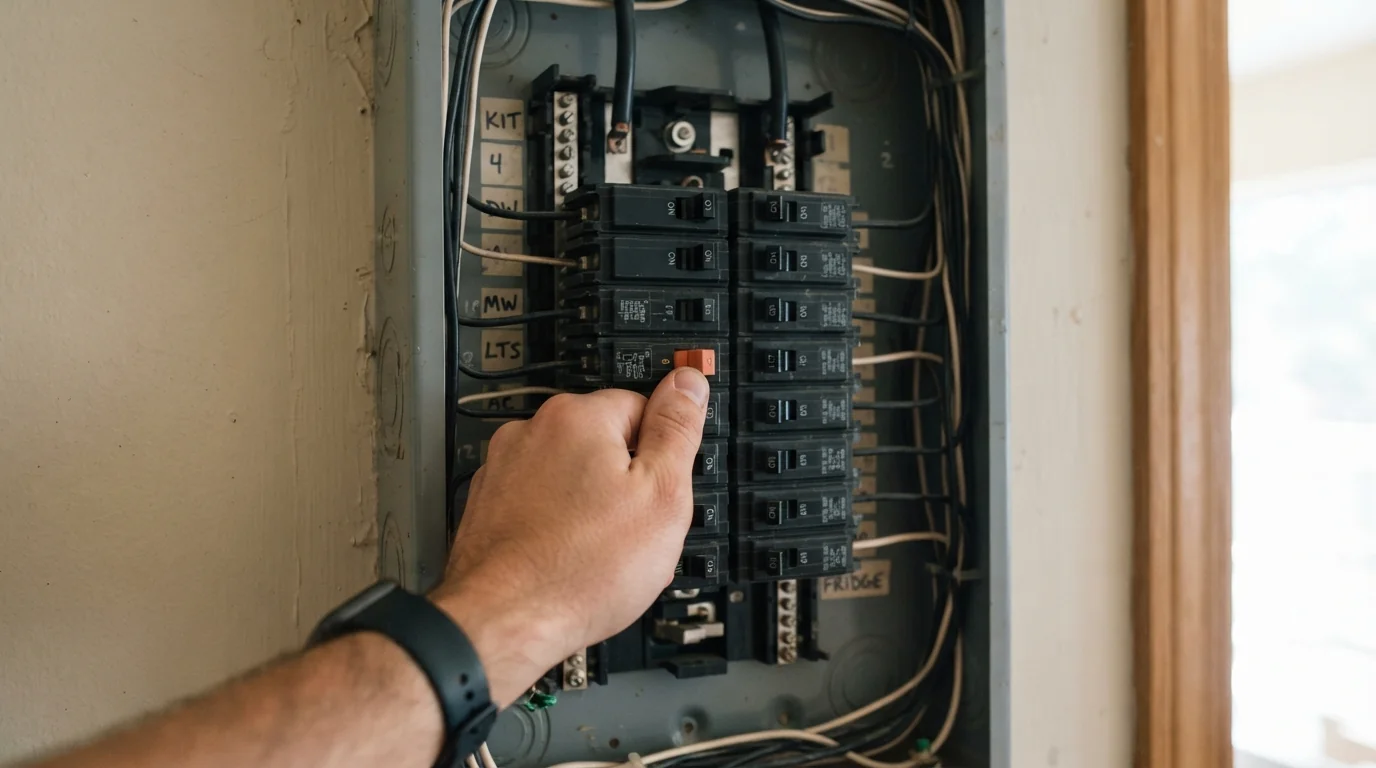
Find the breaker that sits in the middle position or is flipped toward off. Before resetting it, unplug or switch off everything the circuit feeds; in older apartments that can span two rooms, so check outlets beyond the one you were using.
Then push the handle firmly to the full off position and back to on. A tripped breaker will not reset if you only push it toward on.
Step two: bring loads back one at a time
Plug things back in one by one, starting with lights and small devices. What happens tells you a lot.
- Trips when a second heavy appliance starts: the circuit is overloaded, not faulty
- Trips the moment one particular device is plugged in: that device or its cord likely has a fault
- Trips with nothing plugged in: there is a fault in the wiring itself
- Trips at random or overnight: a failing breaker, a loose connection or an arcing fault
When to stop resetting
Stop and call if the breaker trips again immediately with nothing connected, if it feels warm or hot, if you hear buzzing from the panel, if you smell burning plastic, or if you see scorch marks. Each of these points at heat or a fault that resetting only feeds.
If there is smoke or flame, leave and call 911.
It also helps to note the details before calling: which breaker, what was running, what time it happened and whether anything felt warm. Those notes let an electrician test the right circuit under the right conditions instead of waiting for the fault to repeat.

Breaker warm, buzzing or smelling hot?
Stop resetting it. Call any hour and we will tell you what to shut off.
AFCI and GFCI breakers trip for different reasons
Newer breakers with test buttons protect against arcing faults (AFCI) or current leaking to ground (GFCI). Current city code expects AFCI protection in most living areas and GFCI protection near sinks, in bathrooms, garages and outdoors.
An AFCI that trips often may be catching a shared neutral or real arcing in old wiring; a GFCI may be catching moisture or a damaged cord. Both are doing their jobs, and removing them to stop the tripping removes the protection with it.
Why a bigger breaker is never the answer
The breaker is sized to protect the wire behind it. Putting a 20 amp breaker on wire meant for 15 amps stops the tripping and lets the wire overheat inside the wall instead. If a circuit genuinely needs more capacity, the fix is a new circuit, not a bigger breaker.
The usual culprits in New York apartments
Most repeat tripping in older apartments comes from a few familiar loads meeting circuits that were wired for a smaller era. Knowing them makes the pattern easier to read.
- Space heaters, which draw close to a full 15 amp circuit on their own
- Window air conditioners sharing a bedroom circuit with lights and electronics
- Kitchen counters where the microwave, kettle and toaster share one circuit
- Hair dryers on a bathroom outlet that also feeds another room
- Old appliances with damaged cords or failing motors
What an electrician checks
A visit for repeat tripping starts at the panel: the breaker's condition, the wire size behind it, and whether anything is double-tapped or showing heat. Then the circuit gets measured under load with a clamp meter, the wiring insulation is tested, and a thermal camera checks outlets and connections for hot spots.
The answer usually falls into one of four fixes: move a heavy load to another circuit, add a dedicated circuit, repair a fault in the wiring or a device, or replace a worn breaker with one listed for the panel. Knowing which one you need is the point of the visit.
When the problem is not in your apartment
If several circuits misbehave at once, lights dim across the apartment, or large appliances run weakly, the issue may sit in the building's feeder or the utility supply rather than in your panel. In a co-op, condo or rental, that part belongs to the building. An electrician can confirm where the fault is and tell you who has to fix it, while making your side safe.
Keeping it from happening again
Once the cause is known, a few habits prevent the next round of tripping. Spread heavy appliances across circuits rather than running them from one counter or one power strip. Keep space heaters and window units on outlets that are not shared with the rest of the room. Replace appliances whose cords are cracked or whose plugs feel warm. And when a new appliance arrives with a 240 volt plug or a large nameplate rating, plan its circuit before it is delivered rather than after it trips something.
If the pattern returns after all of that, the wiring or the breaker itself is the likely cause, and that is a job for an electrician rather than another reset.
Sources
- NYC Department of Buildings: 2025 NYC Electrical Code
- Don's Electric and Plumbing: New York residential electrical code overview
Figures are planning ranges from published sources, not quotes. Every job is priced after we see it.
Tripping breaker questions
Once or twice while you test appliances is fine. Repeated tripping means there is a cause to find, and each reset puts the wiring through the same stress again.
Usually the microwave shares its circuit with other kitchen loads. A dedicated microwave circuit is the permanent fix in most older kitchens.
Yes. Heat, age and repeated tripping weaken the mechanism, and a worn breaker can trip early or, worse, fail to trip when it should.
It may be detecting arcing or a shared neutral in older wiring.
If it is warm, buzzing or smells burnt, yes; calls are answered 24/7.
Where this guide leads
Circuit breaker repair
See the serviceTracing faults
See the serviceAdding a dedicated circuit
See the service24/7 emergency service
See the serviceMore guides: EV Charger Installation Cost in New York, NY (2026) and NYC Electrical Permits and the 2025 Code Explained
Breaker still tripping?
Call any hour. Tell us what was running when it tripped and we will tell you the next step.