Standby vs portable generator for an Orange County home
Both keep the lights on; they do it very differently. A standby unit starts itself and can run the whole house. A portable unit costs far less and needs someone to set it up. Here is how to choose.
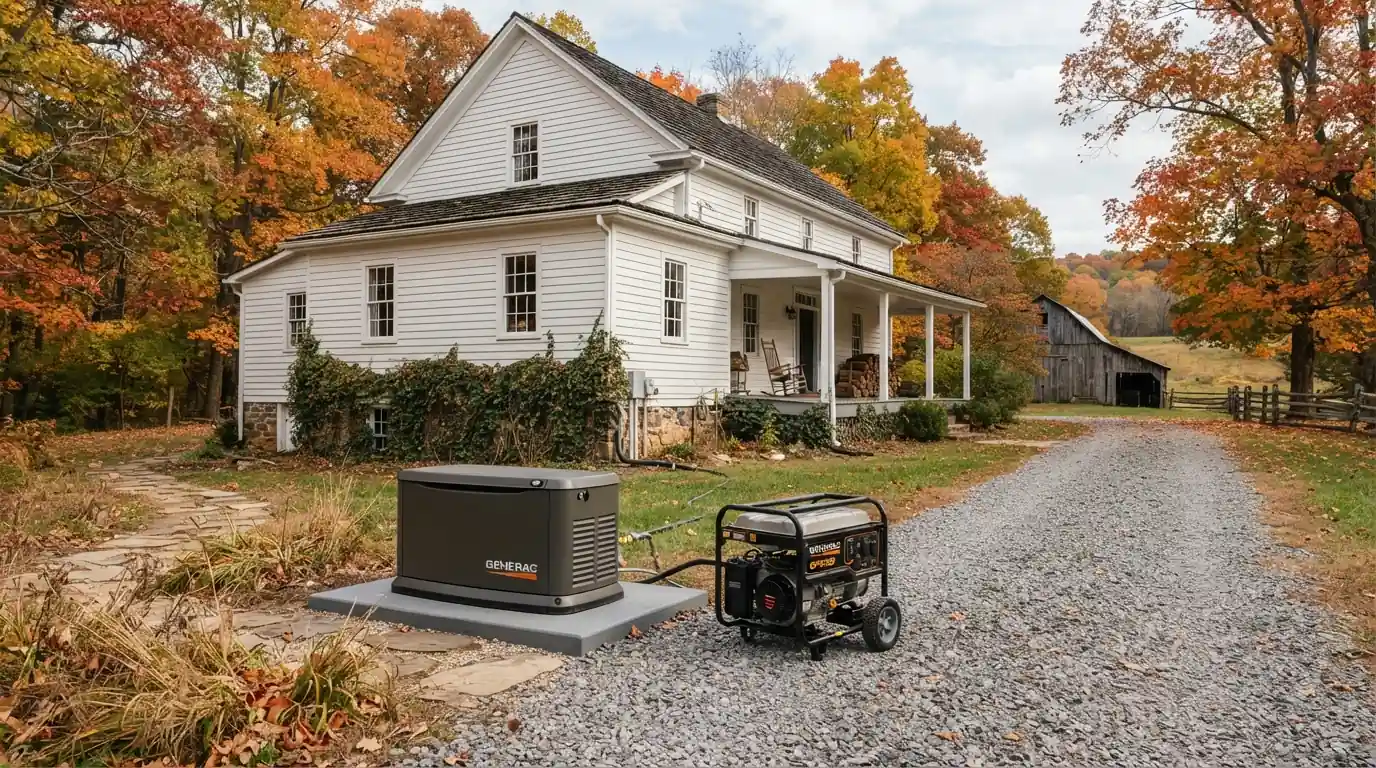
For an Orange County home, a standby generator runs automatically and can power the whole house but costs about $7,000 to $15,000 installed, while a portable generator costs far less but needs a listed interlock or transfer switch and someone to start it. Houses on wells, with sump pumps or with someone always home usually justify standby.
Rather ask a person?(929) 755-0293Why this question comes up so often around Warwick
Outages here are usually caused by summer thunderstorms, ice and falling trees rather than by the grid itself. After one June 2024 storm, Orange and Rockland reported 1,267 customers in the Town of Warwick still without power the next day, and handed out dry ice to help residents keep food cold.
For a house on a well, an outage means no water as well as no lights, and for a house with a sump pump it can mean a flooded basement. That is what makes backup power a practical question rather than a luxury.
The two options side by side
The table below compares the typical setups. Standby costs come from 2026 cost guides; portable setups vary too much by generator size to give a reliable range.
| Portable with interlock | Standby with transfer switch | |
|---|---|---|
| Starts | By hand, when someone is home | Automatically within seconds |
| Runs | Chosen circuits | Essential circuits or the whole house |
| Fuel | Gasoline, sometimes dual-fuel | Natural gas or propane |
| Installed cost | Much lower; depends on the generator | About $7,000 to $15,000 |
| Best for | Occasional outages, budget-minded owners | Wells, sump pumps, medical needs, full-time occupancy |

What each one can realistically power
A mid-size portable generator can run a well pump, the boiler or furnace controls, the refrigerator, some lights and a few outlets, one or two heavy loads at a time. It usually cannot run central air or an electric range alongside everything else.
A standby unit is sized to the house. An essential-circuits unit runs a chosen subpanel; a whole-home unit with load management can run nearly everything, with the biggest loads taking turns.
Losing power every storm season?
Call any hour. We will size the setup to what your house needs to keep running.
How each one connects safely
A portable generator must connect through a listed interlock kit on the panel or a manual transfer switch, fed from an outdoor inlet box. Plugging a generator into a wall outlet sends power back through the house into the utility lines, which can injure line workers; the utility itself warns never to do it.
A standby generator connects through an automatic transfer switch that disconnects the utility, starts the engine and moves the circuits over, then switches back when power returns. Either way, the connection is permitted and inspected work.
Costs beyond the generator
For standby units, 2026 guides put the transfer switch and electrical work at about $1,500 to $3,500 of the total, and a subpanel for essential circuits at $500 to $2,000. The gas connection needs a licensed fitter, and propane needs a tank and deliveries. For portable units, the interlock, inlet box, generator breaker and a properly rated cord are the main electrical costs, plus fuel storage. A standby unit also needs yearly service, so budget for that from the first year.
Fuel and placement
Standby units run on natural gas where the meter can supply it, or propane where there is no gas service, which is common in rural parts of the county. Both types must sit outdoors at the manufacturer's clearances from windows, doors and vents, because generator exhaust contains carbon monoxide. A portable unit should never run in a garage, even with the door open, and every home using one needs working CO alarms.
How to decide
If outages are occasional, someone is usually home, and the house can manage without central air for a day, a portable generator with a proper interlock is sensible and affordable. If the house is on a well, has a sump pump, has someone with medical equipment, or is often empty during storms, standby earns its cost. Many owners start with a portable setup and move to standby later; if you think you might, size the interlock and inlet with that in mind.
Maintenance to plan for
Standby generators exercise themselves on a schedule, usually weekly, and need periodic oil, filter and battery service to start reliably when it matters. Portable generators need fresh or stabilized fuel, a periodic test run under load, and a dry place to live between storms. A generator that has not run since last winter is the one most likely to fail on the first cold night, so put the test run on the calendar each fall.
What a site visit covers
A site visit answers the questions that decide the choice. It checks the panel for a listed interlock or room for a transfer switch, measures the loads you want to keep running, looks at where a generator can sit at the required clearances, and checks whether gas service can supply a standby unit or propane is needed. You leave with a clear comparison for your house rather than a general answer.
Sources
- Always Do Better: generator installation cost 2026
- Inch Calculator: backup generator cost guide
- Orange and Rockland: June 2024 storm restoration update
Figures are planning ranges from published sources, not quotes. Every job is priced after we see it.
Generator questions
Often, if the generator can handle the pump's starting surge. The pump's nameplate tells you what size generator it needs.
No, and it is dangerous. It can send power back into the utility lines and injure line workers.
2026 guides put most installs at about $7,000 to $15,000, with the transfer switch and electrical work making up part of that.
Natural gas where the meter can supply it; propane where there is no gas service, which is common in rural Orange County.
Yes. Many owners do, and the interlock and inlet can be sized with a future upgrade in mind, so the portable setup still earns its keep as a backup to the standby unit.
Where this guide leads
Standby generator installation
See the serviceInterlock kits and transfer switches
See the serviceStorm damage repair
See the serviceSurge protection
See the serviceMore guides: Local Law 97 and Your Building's Electrical Capacity and Signs Your New York Apartment Wiring Needs Replacing
Choose the right backup power
Call any hour. Tell us what must keep running and we will explain both options.